Abraham Lincoln, Trial Lawyer: The Almanac Trial and Other Cases
Abraham Lincoln's 25-year law career, the 1858 Duff Armstrong almanac trial and other notable cases, with free online sources for his legal papers.
Suppose a witness swears he saw a fatal blow struck at night because the Moon was shining almost overhead, bright as day. The case seems settled until the defense lawyer opens an almanac and shows the jury that the Moon was low in the sky, close to setting. That scene, from a murder trial in Illinois in 1858, is the best-known moment of Abraham Lincoln's legal career, and it is only one of thousands of cases he handled before he became president.
This page explains what Lincoln's working life as a lawyer looked like, what actually happened in the "almanac trial," which other cases are worth knowing, and where to find the documents yourself. The surviving court papers are unusually complete, and nearly all of them are free online.
Lincoln's law career in numbers
Lincoln was admitted to the bar in 1836 and practiced in Springfield, Illinois, until he left for Washington in February 1861. He worked in three partnerships:
| Partner | Years |
|---|---|
| John T. Stuart | 1837–1841 |
| Stephen T. Logan | 1841–1844 |
| William H. Herndon | 1844–1861 (formally until Lincoln's death in 1865) |
The editors of The Law Practice of Abraham Lincoln, a documentary edition built from court records across Illinois and beyond, collected 96,386 documents describing 5,173 cases and nearly 500 non-litigation matters involving Lincoln and his partners. Their statistical portrait is the best antidote to the image of Lincoln as an occasional courtroom hero. Most of the work was ordinary: debt collection, contracts, land disputes, divorces, slander suits and appeals. He argued 1,257 cases before Judge David Davis between 1849 and 1861, many while traveling the Eighth Judicial Circuit, the rural court circuit of central Illinois. He and his partners took part in 133 cases for or against railroad companies, representing railroads slightly less often than they opposed them, and 332 of their cases began in federal court.
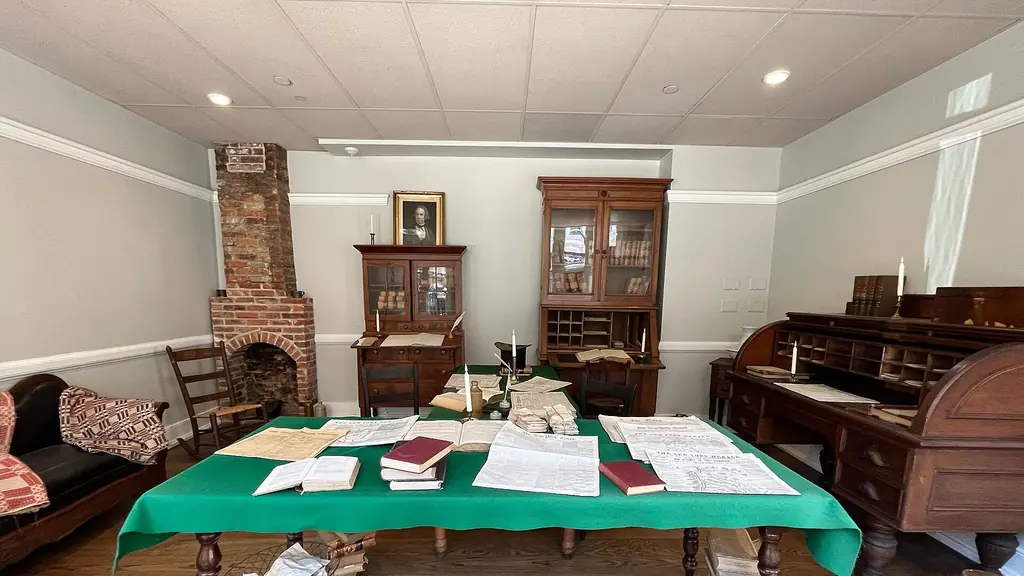
Only one building where Lincoln kept a law office still stands: the Lincoln-Herndon Law Offices in Springfield, now a state historic site (closed for renovation at the time of writing).
The almanac trial: People v. Armstrong (1858)
William "Duff" Armstrong was the son of Jack and Hannah Armstrong, friends of Lincoln's from his young-man years in New Salem. Duff was charged with murder after a man named Preston Metzker was struck in the head during a fight near a religious camp meeting in Mason County, Illinois; Metzker rode home and died days later. The prosecution claimed Armstrong had used a slung-shot, a weighted weapon similar to a blackjack.
The case was moved to Beardstown in neighboring Cass County, and the trial took place in May 1858. The key prosecution witness, Charles Allen, testified that he had seen the blow by moonlight, with the Moon high and bright. Lincoln produced an almanac showing that at the time in question the Moon was near the horizon and about to set, undermining the claim that Allen could have seen clearly from where he stood. After Lincoln's closing argument, the jury returned a unanimous verdict of not guilty. Lincoln is reported to have charged the family no fee.
Why historians still discuss it
The almanac trial became a legend almost at once, and legends attract embellishment. When you read about it, keep three questions in mind:
- What did the almanac actually show? Look for accounts that state the Moon's position, not just that the almanac "proved the witness lied." Undercutting a witness's view is not the same as proving innocence.
- What else was in evidence? A murder trial turns on more than one witness. Look for what accounts say about the weapon, the cause of death and the other testimony; the almanac was one part of a defense, not the whole of it.
- Who is telling the story, and when? Many vivid details come from reminiscences recorded decades later, after Lincoln's assassination had made every story about him valuable.
Try it: Read the Abraham Lincoln Presidential Library's short article on People v. Armstrong, then search for the case in the Law Practice of Abraham Lincoln database. List which details you can confirm from court documents and which come only from later retellings.
Other cases worth knowing
- The Matson slave case (1847). In the Coles County circuit court, Lincoln represented Robert Matson, a Kentucky slaveholder who sought to take Jane Bryant and her children back into slavery after bringing them to work on his Illinois farm. Lincoln argued that a slaveholder could bring enslaved people into a free state temporarily without freeing them. The court rejected Matson's claim and the Bryants were freed. The case is a reminder that lawyers then, as now, took clients whose causes they did not share, and it complicates simple portraits of Lincoln.
- The Effie Afton case (1857). After the steamboat Effie Afton struck a pier of the first railroad bridge across the Mississippi River at Rock Island in May 1856 and burned, its captain sued the bridge company. Lincoln was among the company's lawyers in the federal circuit court in Chicago. The jury could not agree, so the boat's owners recovered nothing, and the case became an early battle between river and railroad interests.
- Railroad cases. Lincoln worked both for and against railroads, including the Illinois Central Railroad, which he represented in ten cases before the Illinois Supreme Court. The statistical portrait shows how central such cases became to his practice in the 1850s.
How to research Lincoln's legal papers
- Start with the case database. The Law Practice of Abraham Lincoln can be searched for a case or a person's name, and each case file gathers the surviving documents.
- Read the documents, not just the summaries. Declarations, pleas, jury lists, verdicts and fee records show how a case actually unfolded.
- Use the Papers of Abraham Lincoln for letters and other documents that mention his legal work, and for the project's broader digital editions.
- Add context. Biographies and the Miller Center's overview of Lincoln's life before the presidency place the cases in his political rise.
- Visit if you can. The Lincoln Home National Historic Site and the Abraham Lincoln Presidential Library and Museum in Springfield interpret his life as a lawyer and neighbor.
Tip: Older books and websites sometimes credit Lincoln with "never losing a case" or with inventing courtroom tactics. Check any such claim against the documentary edition; its numbers show a busy, successful lawyer who also lost his share of cases.
Lincoln's cases belong to a longer story told in our guide to historical law, founding documents and famous trials, alongside the trial of Joan of Arc. To work out the Moon's position for yourself on any date, see astronomy and space science resources and almanacs and fact books online. Teachers will find document-analysis tools in teaching with primary sources.
Recommended resources
- The Law Practice of Abraham Lincoln — The complete documentary edition of Lincoln's legal cases, with a searchable database of case files and supporting documents (Papers of Abraham Lincoln, Abraham Lincoln Presidential Library; free).
- A Statistical Portrait of Lincoln's Law Practice — The editors' analysis of the caseload: numbers of cases, courts, partners, railroad work and more; a strong basis for any essay (The Law Practice of Abraham Lincoln; free).
- Papers of Abraham Lincoln — Searchable transcriptions of documents written by and to Lincoln, by author, recipient, subject and date (Abraham Lincoln Presidential Library; free).
- People v. Armstrong — A short account of the almanac trial and of Lincoln's later help to the Armstrong family (Abraham Lincoln Presidential Library and Museum; free).
- Abraham Lincoln Presidential Library and Museum — The state library and museum in Springfield that holds major Lincoln collections and runs the Papers project (State of Illinois; free website).
- Lincoln Home National Historic Site — The Springfield house where Lincoln lived while practicing law, with history pages about his neighborhood and career (National Park Service; free).
- Lincoln-Herndon Law Offices State Historic Site — The only surviving building in which Lincoln kept a law office, including restored offices and a federal courtroom; check the page for its reopening (Illinois Department of Natural Resources; free).
- Abraham Lincoln: Life Before the Presidency — A scholarly overview of Lincoln's early life, law practice and political career (Miller Center, University of Virginia; free).
- Papers of Abraham Lincoln: project history — How the Lincoln Legal Papers project gathered more than 96,000 documents and grew into today's Papers of Abraham Lincoln (National Archives, NHPRC; free).
- Collision of Interests — An article on the Effie Afton case and the fight between river and railroad interests (Commonplace: The Journal of Early American Life; free).
- The Matson Slave Trial — A local-history page on the 1847 Coles County case and the people involved (Eastern Illinois University; free).
Sources
- The Law Practice of Abraham Lincoln: A Statistical Portrait, The Law Practice of Abraham Lincoln: Complete Documentary Edition
- People v. Armstrong, Abraham Lincoln Presidential Library and Museum
- Papers of Abraham Lincoln (NHPRC project description), National Archives, National Historical Publications and Records Commission
- Collision of Interests, Commonplace: The Journal of Early American Life
- Lincoln-Herndon Law Offices State Historic Site, Illinois Department of Natural Resources, Historic Preservation Division