FDR's Fourth Inaugural Address (1945): The Short Wartime Inauguration
Franklin Roosevelt's brief fourth inaugural on January 20, 1945: why it was held at the White House, what the speech says, its context, and where to read it.
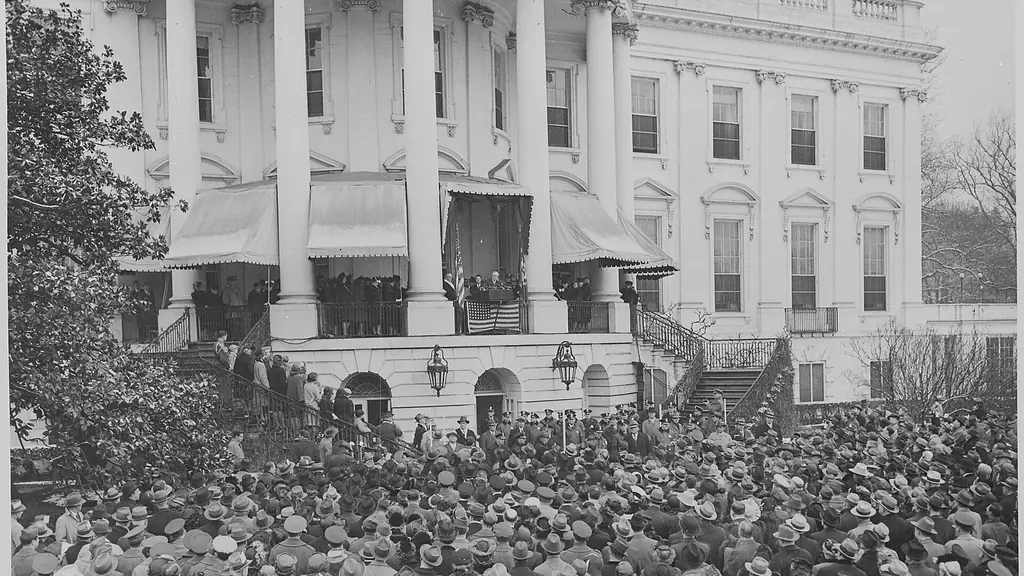
On a cold Saturday in January 1945, a few thousand guests stood on snow-covered ground behind the White House while Franklin D. Roosevelt took the presidential oath for the fourth time. There was no parade and no grand procession down Pennsylvania Avenue. The address that followed lasted only five or six minutes, and the whole ceremony was over in less than a quarter of an hour.
The fourth inauguration was unusual in almost every way: the only fourth term in American history, the first inauguration held at the White House, one of the shortest inaugural addresses ever delivered, and the last public ceremony of a president who would be dead within three months. This page explains the circumstances, summarizes what the speech says, and points to reliable full texts and recordings for study and teaching.
The setting: January 20, 1945
The United States was in the final year of World War II. As the National WWII Museum describes it, the Battle of the Bulge was drawing to a close in Europe, Soviet forces were advancing in Poland, fighting continued in the Philippines, and the invasion of Iwo Jima was being planned. Roosevelt was preparing for the Allied leaders' conference at Yalta, held in early February.
Roosevelt asked that the ceremony be simple and brief. Instead of the usual platform at the Capitol, the oath was taken on the South Portico of the White House, the first time an inauguration had been held there. The FDR Presidential Library notes that the change was officially attributed to wartime austerity, and that the president's declining health may also have played a part. According to the National WWII Museum:
- Only about 7,000 tickets were issued for the White House grounds, and guests stood on canvas over wet snow.
- Fifty places were reserved for wounded service members.
- The ceremony consisted of an invocation, the oaths of office for the vice president and the president, the address and the national anthem, and took about twelve and a half minutes.
- It was the first time in three months that Roosevelt had given a speech standing, and he was visibly thinner.
Chief Justice Harlan Fiske Stone administered the presidential oath. Harry S. Truman was sworn in as vice president by the outgoing vice president, Henry A. Wallace; the museum notes this was the last inauguration at which an outgoing vice president swore in a successor.
The speech in brief
The address runs to roughly 550 to 560 words, depending on the transcription counted. The National WWII Museum calls it the shortest inaugural address since George Washington's second in 1793. Despite its length, it moves through a clear sequence:
- The test. Roosevelt describes Americans and their allies as passing through a supreme test of courage, resolve and democracy, and pledges that the nation will not fail.
- Peace as the goal. He promises to work for a just and durable peace even while fighting for total victory.
- Striving, not perfection. He admits that mistakes will be made but insists they must not come from weakness or abandoned principle, and recalls his old schoolmaster's lesson that civilization's long trend is upward despite its peaks and valleys.
- An imperfect foundation. He calls the Constitution of 1787 imperfect, then and still, but a firm base on which to build democracy.
- Lessons of the war. The nation, he says, has learned at fearful cost that it cannot live alone and that its well-being depends on other nations.
- Friendship and trust. Quoting Emerson, he argues that lasting peace cannot be built on suspicion or fear.
- A closing prayer for the vision to find the way to a better life and to peace.
Two lines are quoted most often. Roosevelt declared, "We have learned to be citizens of the world, members of the human community." And he borrowed from Ralph Waldo Emerson: "The only way to have a friend is to be one." Both point toward the international organization the Allies were planning, which would become the United Nations later that year.
Why it matters
The fourth inaugural is often overlooked beside the famous first address of 1933, but it rewards attention as a document of transition. It is a wartime speech that barely mentions the fighting, focusing instead on what should follow it. It shows a president making the case for international cooperation to a country with a strong isolationist tradition. And it captures a leader near the end: Roosevelt died on April 12, 1945, in Warm Springs, Georgia, after returning from the long journey to Yalta.
The occasion also marked a constitutional turning point. Roosevelt remains the only president elected more than twice. The Twenty-second Amendment, ratified in 1951, limits presidents to two elected terms, so no future president can have four inaugurations. Our guide to the constitutional amendments covers its text and history, and our overview of all four of Roosevelt's inaugural addresses compares them.
Tip: Word counts and running times for this speech vary slightly between sources because transcripts differ in small details. If you cite a figure, name the source you took it from.
Studying the address
The speech is short enough to read closely in a single class period, and a recording survives.
Try it: Read the full text on the Avalon Project, then listen to the NBC radio recording held by the National Archives. Mark every sentence that begins "We have learned." What lessons does Roosevelt list, and which of them are about the war itself? Then compare the opening sentence with the first paragraph of his 1933 address.
Questions for discussion or writing:
- Why might Roosevelt have chosen to say so little about military events in a wartime address?
- What does the comparison to the Constitution of 1787 suggest about how he viewed American democracy?
- How does the speech prepare listeners for the idea of a postwar international organization?
- What do the austerity of the ceremony and its setting communicate on their own?
Checklist for citing an inaugural address: speaker, title, date of delivery, the edition or website you used, and the date you accessed it. Prefer an authoritative transcript, such as the Avalon Project, the Miller Center or the American Presidency Project, over an unattributed copy.
For other addresses, see our guide to presidential inaugural addresses; for classroom methods, see teaching with primary sources. More guides are on the History and Geography subject page.
Recommended resources
- Fourth Inaugural Address (Avalon Project) — A clean, reliable transcript of the full address, part of the Avalon Project's collection of inaugural speeches and historical documents. (Lillian Goldman Law Library, Yale Law School; free.)
- Fourth Inaugural Address (Miller Center) — The text of the address within the Miller Center's searchable archive of presidential speeches. (Miller Center, University of Virginia; free.)
- Franklin D. Roosevelt (Miller Center) — Scholarly essays on Roosevelt's life, domestic and foreign policy, and death, useful for context. (Miller Center, University of Virginia; free.)
- DocsTeach: Franklin Roosevelt's Fourth Inaugural Address — The NBC radio recording of the address with a description and citation, ready for classroom activities. (National Archives; free.)
- National Archives Catalog record — The archival description of the sound recording, for researchers who need the official catalog citation. (National Archives; free.)
- FDR's Four Historic Inaugurations — A short history of all four Roosevelt inaugurations from the presidential library's blog, with photographs. (FDR Presidential Library and Museum; free.)
- FDR Presidential Library and Museum — The library and museum in Hyde Park, New York, holding Roosevelt's papers, with digital collections and education programs. (National Archives; free online.)
- Inauguration Day 1945 — A detailed account of the ceremony, its wartime setting and Roosevelt's health. (The National WWII Museum; free.)
- A historical first and last — A brief article on the constitutional significance of the only fourth-term inauguration. (National Constitution Center; free.)
- The Yalta Conference, 1945 — The State Department historians' summary of the conference Roosevelt attended weeks after the inauguration. (Office of the Historian, U.S. Department of State; free.)
- History Unfolded: FDR Delivers His Fourth Inaugural Address — How American newspapers reported the inauguration, with links to contemporary articles. (United States Holocaust Memorial Museum; free.)
- Teaching American History: Inaugural Address (1945) — The full text, with a citation to its American Presidency Project source, inside a large primary-source collection built for history teachers. (Teaching American History; free.)
- The Constitution: Amendments 11-27 — The text of the Twentieth Amendment, which moved Inauguration Day to January 20, and the Twenty-second, which limits presidential terms. (National Archives; free.)
- Home of Franklin D. Roosevelt National Historic Site — Roosevelt's lifelong home at Springwood in Hyde Park, with history pages and visitor information. (National Park Service; free.)
Sources
- Fourth Inaugural Address of Franklin D. Roosevelt, The Avalon Project, Lillian Goldman Law Library, Yale Law School
- FDR's Four Historic Inaugurations, Franklin D. Roosevelt Presidential Library and Museum, National Archives
- Inauguration Day 1945: FDR's Ceremony at the White House, The National WWII Museum
- Franklin Roosevelt's Fourth Inaugural Address (sound recording), DocsTeach, National Archives
- A historical first and last: FDR's final inauguration, National Constitution Center