Presidential Inaugural Addresses: A Guide to the Complete Texts
Every U.S. presidential inaugural address from 1789 to 2025 in one table, with where to read the full texts, key traditions and ideas for using them in class.
Suppose your class is studying how presidents describe the nation's purpose, and each student must analyze one inaugural address. Where do you find a trustworthy text, and how do you know which addresses exist? The Constitution prescribes the presidential oath but says nothing about a speech. Even so, every president who has been elected to office has given an inaugural address, beginning with George Washington in New York City in 1789.
This page lists every inaugural address in order, explains a few traditions and records, and points to the archives and university projects that publish complete, reliable texts. Inaugural addresses are public documents, free to read and quote.
Where to read the complete texts
Four free sources cover every address, and each has strengths:
- The Avalon Project at Yale Law School: plain, stable texts of every address on a single index page. Easy to print and cite.
- The American Presidency Project at UC Santa Barbara: every address within a large searchable archive of presidential documents, so you can compare an inaugural address with the same president's later speeches.
- The Miller Center at the University of Virginia: texts paired with audio and video for modern addresses, plus scholarly essays on each presidency.
- The Library of Congress resource guide on presidential inaugurations: primary sources about the ceremonies themselves, such as manuscripts, programs, photographs and sheet music, arranged by period.
For the earliest addresses, the National Archives also holds Washington's handwritten first inaugural speech and presents it with a transcript among its milestone documents.
Tip: Copies of famous speeches on random websites often drop paragraphs or "improve" wording. For schoolwork, cite one of the archives above and note the date you accessed it.
All inaugural addresses, 1789 to 2025
Presidents who first took office on the death or resignation of a predecessor, such as John Tyler, Millard Fillmore, Andrew Johnson, Chester Arthur and Gerald Ford, did not give a formal inaugural address for that partial term. Several of them, and others including Theodore Roosevelt, Calvin Coolidge, Harry Truman and Lyndon Johnson, gave one only after winning election in their own right. That is why the list below has gaps.
| President | Address year(s) |
|---|---|
| George Washington | 1789, 1793 |
| John Adams | 1797 |
| Thomas Jefferson | 1801, 1805 |
| James Madison | 1809, 1813 |
| James Monroe | 1817, 1821 |
| John Quincy Adams | 1825 |
| Andrew Jackson | 1829, 1833 |
| Martin Van Buren | 1837 |
| William Henry Harrison | 1841 |
| James K. Polk | 1845 |
| Zachary Taylor | 1849 |
| Franklin Pierce | 1853 |
| James Buchanan | 1857 |
| Abraham Lincoln | 1861, 1865 |
| Ulysses S. Grant | 1869, 1873 |
| Rutherford B. Hayes | 1877 |
| James A. Garfield | 1881 |
| Grover Cleveland | 1885, 1893 |
| Benjamin Harrison | 1889 |
| William McKinley | 1897, 1901 |
| Theodore Roosevelt | 1905 |
| William Howard Taft | 1909 |
| Woodrow Wilson | 1913, 1917 |
| Warren G. Harding | 1921 |
| Calvin Coolidge | 1925 |
| Herbert Hoover | 1929 |
| Franklin D. Roosevelt | 1933, 1937, 1941, 1945 |
| Harry S. Truman | 1949 |
| Dwight D. Eisenhower | 1953, 1957 |
| John F. Kennedy | 1961 |
| Lyndon B. Johnson | 1965 |
| Richard Nixon | 1969, 1973 |
| Jimmy Carter | 1977 |
| Ronald Reagan | 1981, 1985 |
| George H. W. Bush | 1989 |
| Bill Clinton | 1993, 1997 |
| George W. Bush | 2001, 2005 |
| Barack Obama | 2009, 2013 |
| Donald J. Trump | 2017, 2025 |
| Joseph R. Biden Jr. | 2021 |
Re-Quest has separate pages on Jimmy Carter's 1977 address, Franklin D. Roosevelt's four addresses, FDR's short wartime fourth address of 1945 and Barack Obama's two addresses.
Traditions, records and firsts
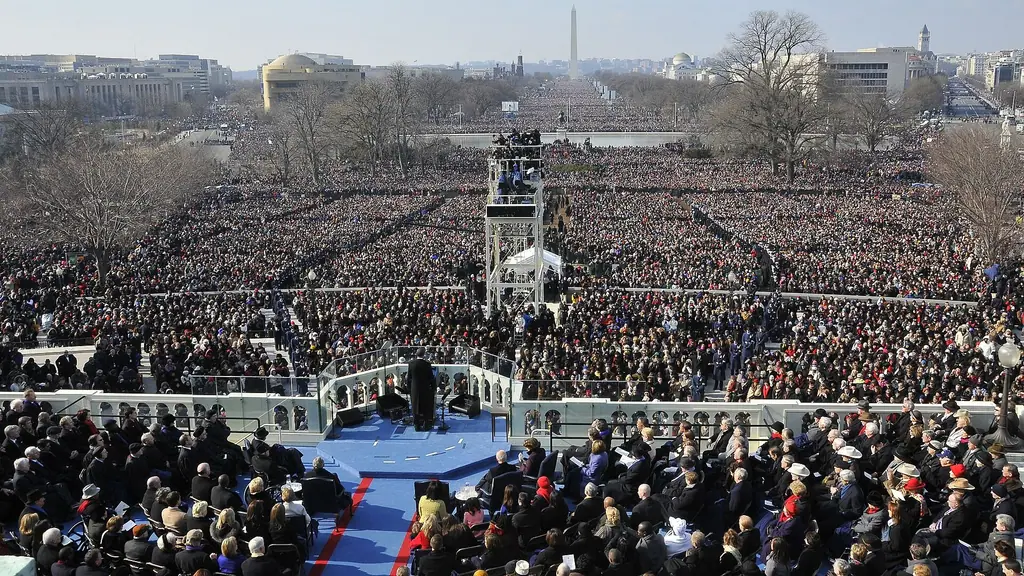
Place. Washington's first inauguration took place at Federal Hall in New York City, then the capital; his second, in 1793, in Philadelphia. Thomas Jefferson's first inauguration in 1801 was the first held in Washington, D.C. For much of the 19th and 20th centuries the ceremony was held on the Capitol's East Front; Ronald Reagan's first inauguration in 1981 moved it to the West Front, facing the National Mall. Extreme cold sent Reagan's second public ceremony indoors, to the Capitol Rotunda, in 1985.
Date. Until 1933, presidential terms began on March 4. The 20th Amendment, ratified in 1933, moved the start of the term to noon on January 20, and Franklin Roosevelt's second inauguration in 1937 was the first held on that date. When the date has fallen on a Sunday, the public ceremony has been held on Monday; in recent practice the president also takes the oath privately on the Sunday.
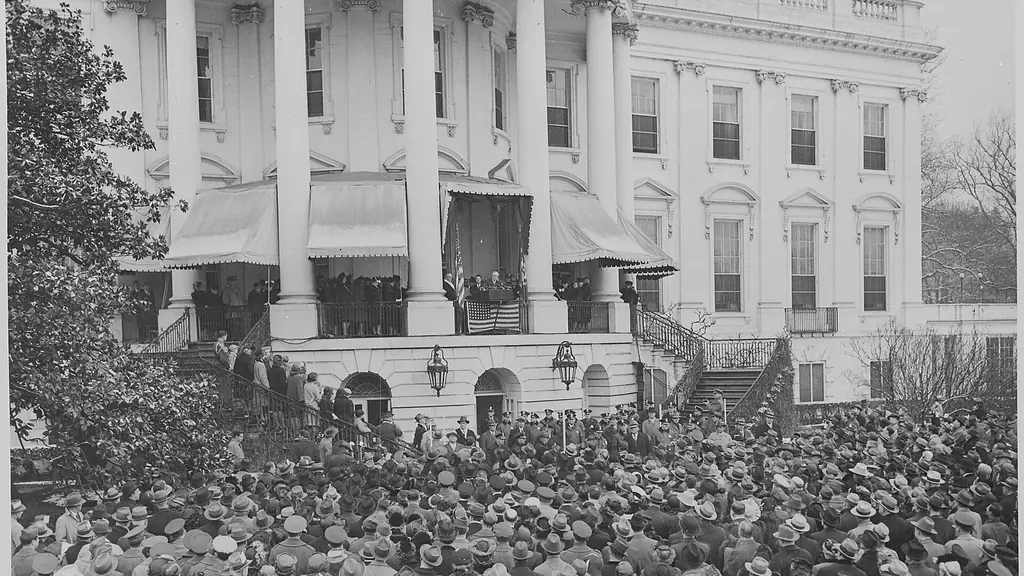
Length. Washington's second inaugural address, at 135 words, is the shortest on record. William Henry Harrison's in 1841, at roughly 8,400 words, is the longest; he died a month after taking office. Franklin Roosevelt's fourth address in 1945, delivered at the White House during World War II, is one of the shortest of the modern era.
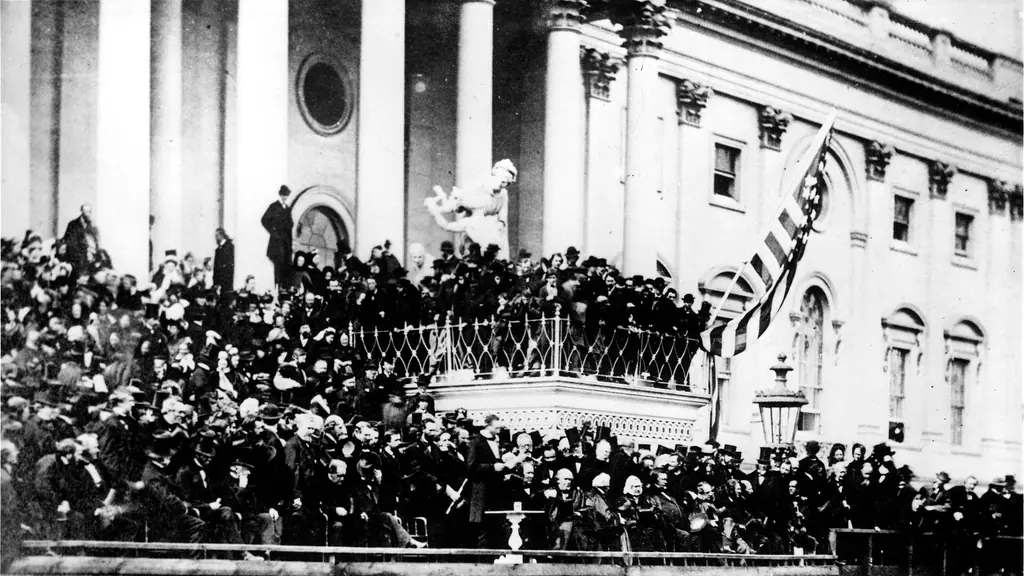
Famous lines. A few sentences have outlived their speeches: Lincoln's call in 1865 for "malice toward none"; Franklin Roosevelt's 1933 assurance that "the only thing we have to fear is fear itself"; and John F. Kennedy's 1961 appeal to ask what you can do for your country rather than what it can do for you. Read in context, each is the climax of an argument that runs through the whole address.
Using inaugural addresses in class
Inaugural addresses are short, dated and comparable, which makes them excellent primary sources. Some approaches that work at middle school through college level:
- Context first. Before reading, list three things happening in the country that year. Then see which of them the president mentions, and which he avoids.
- Compare across a crisis. Pair addresses given in hard times, such as Lincoln in 1861, Franklin Roosevelt in 1933 and another of your choice, and compare how each speaker names the problem and offers reassurance.
- Track a word. Use the American Presidency Project's search to trace a term like "liberty," "union" or "freedom" across two centuries of addresses.
- Read and listen. For addresses from the 20th century on, listen to the delivery on the Miller Center site while reading the text, and note where emphasis changes meaning.
Try it: Choose two addresses at least 100 years apart. For each, write one sentence summarizing its main promise and one sentence describing its tone. Then explain one way the country's situation shaped each speech, citing a specific passage from each.
For more on working with documents like these, see teaching with primary sources or browse History and Geography.
Recommended resources
- The Inaugural Addresses of the Presidents — Index linking the full text of every inaugural address from 1789 onward (The Avalon Project, Yale Law School; free).
- Inaugural Addresses — Every address in a searchable archive of presidential documents, ideal for word and theme comparisons (American Presidency Project, UC Santa Barbara; free).
- Presidential Speeches — Searchable speech archive with audio and video for modern addresses (Miller Center, University of Virginia; free).
- U.S. Presidential Inaugurations: A Resource Guide — Primary sources on every inauguration, from diaries and letters to photographs and sheet music (Library of Congress; free).
- President George Washington's First Inaugural Speech (1789) — Images of the handwritten original with a transcript and background (National Archives; free).
- Milestone Documents — Key documents of American history with transcripts, useful for pairing inaugural addresses with the laws and events they discuss (National Archives; free).
- 20th Amendment — Text of the amendment that moved Inauguration Day to January 20, with annotations (Legal Information Institute; free).
- The Constitution: Amendments 11-27 — Transcriptions of later amendments, including the 20th and the 22nd, which limits presidents to two elected terms (National Archives; free).
- Federal Hall National Memorial — The National Park Service site on the New York location of Washington's first inauguration (NPS; free).
- DocsTeach — Ready-made primary-source activities from the National Archives that teachers can adapt for inaugural address lessons (National Archives; free, optional teacher account).
Sources
- U.S. Presidential Inaugurations: A Resource Guide, Library of Congress
- The Inaugural Addresses of the Presidents, The Avalon Project, Yale Law School
- Inaugural Addresses, The American Presidency Project, UC Santa Barbara
- 20th Amendment, Legal Information Institute, Cornell Law School
- President George Washington's First Inaugural Speech (1789), National Archives