Ancient Law Codes: From Ur-Nammu to Justinian, a Reading Guide
What survives of early written law, from Ur-Nammu and Hammurabi to the Twelve Tables and Justinian, and where to read reliable translations of each code.

Imagine you are asked to compare punishments in Hammurabi's laws with those in the Twelve Tables. You find a translation online, copy a striking line about an eye for an eye, and later discover that another translation words it differently, numbers the laws differently, and fills a damaged passage with a guess. Which version is right?
Ancient law codes are some of the most fascinating documents to survive from the early world, and some of the easiest to misuse. They come to us broken, copied by later scribes, written in dead languages and translated by scholars who disagree. This guide outlines the major early codes in order, explains what kind of evidence each is, and points to dependable translations and museum records so you can read them with care.
A timeline of early written law
Dates for the oldest codes are approximate, and scholars revise them. Treat the dates below as conventional estimates.
| Code | Approximate date | Place and language | How it survives |
|---|---|---|---|
| Laws of Ur-Nammu | About 2100 BCE | Ur, southern Mesopotamia; Sumerian | Later copies on clay tablets, fragmentary |
| Laws of Lipit-Ishtar | About 1930 BCE | Isin, Mesopotamia; Sumerian | Fragmentary tablets |
| Laws of Hammurabi | Reign 1792–1750 BCE | Babylon; Akkadian | A basalt stele in the Louvre, plus tablet copies |
| Hittite Laws | Second millennium BCE | Anatolia; Hittite | Tablets from the Hittite capital |
| Middle Assyrian Laws | About 1075 BCE | Assyria; Akkadian | Tablets from Assur |
| Twelve Tables | 451–450 BCE | Rome; Latin | Lost; known only through quotations by later writers |
| Justinian's codification | 529–534 CE | Constantinople; Latin | Manuscripts copied through the Middle Ages |
Mesopotamia: Ur-Nammu, Lipit-Ishtar and Hammurabi
The laws attributed to Ur-Nammu, founder of the Third Dynasty of Ur, are generally treated as the oldest law collection known to survive. Only part of the text remains, and some scholars think his son Shulgi was responsible. The Lipit-Ishtar laws, from the city of Isin about two centuries later, follow a similar pattern of prologue, laws and epilogue; the companion page on the laws of Lipit-Ishtar looks at them closely.
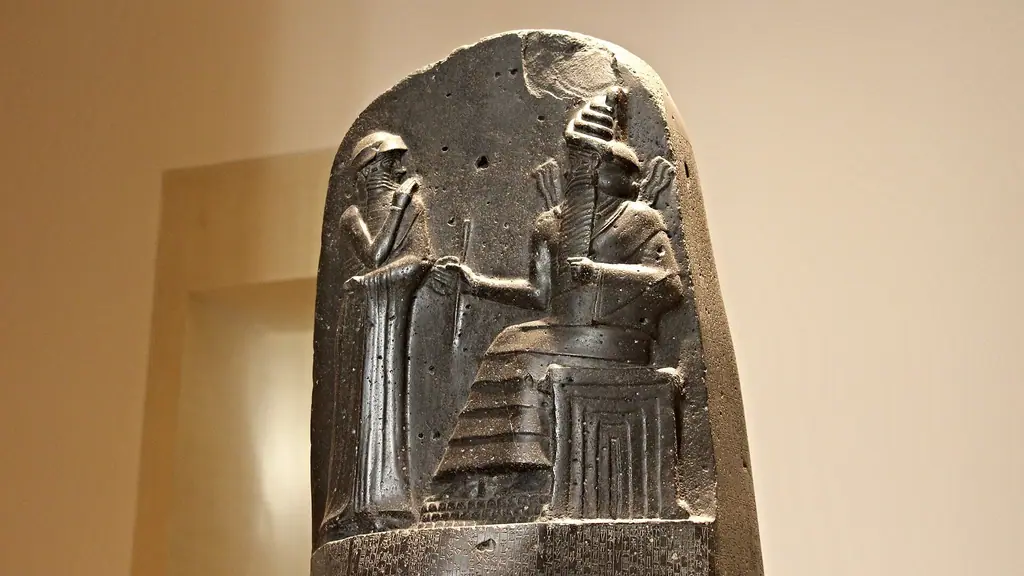
Hammurabi's laws are the best known because one monument survives nearly whole. The Louvre's record describes a basalt stele about 2.25 meters tall, found at Susa in 1901–1902, where it had been carried as war booty centuries after it was made. A relief at the top shows the king before the sun god Shamash; below, the laws are carved in columns of cuneiform. For the text, translations and teaching approaches, see the dedicated page on the Code of Hammurabi.
Two cautions apply to all of these. First, the word "code" is a modern label. Many historians argue these collections were royal statements of justice and examples of good judgments rather than complete rulebooks that judges consulted. Second, punishments often depended on social rank: penalties for harming a free person, a commoner or an enslaved person could differ sharply.
Hittite and Assyrian laws
Hittite law tablets found in Anatolia reveal a legal culture that often favored compensation, such as payments of silver or livestock, over physical punishment, and later versions show revisions that reduced some penalties. The Middle Assyrian laws, by contrast, include harsh provisions, many concerning women and family life. Reading them side by side is a good reminder that there was no single "ancient Near Eastern law."
Rome: the Twelve Tables and Justinian
According to Roman tradition, the Twelve Tables were drawn up around 451–450 BCE by a commission of ten men after pressure from ordinary citizens who wanted written, public rules. The original bronze or wooden tablets are lost. What we read today is a modern reconstruction assembled from quotations in later Roman authors, so the ordering of the "tables" in any translation is a scholarly arrangement, not the original layout.
Nearly a thousand years later, the emperor Justinian ordered a vast codification of Roman law, carried out between 529 and 534 CE. It comprised the Code (imperial enactments), the Digest (excerpts from Roman jurists), and the Institutes (a textbook for students), joined later by new laws known as the Novels. Rediscovered and studied in medieval Europe, this body of law shaped the civil law systems used across much of the world today.
Medieval England: the laws of William the Conqueror
Texts attributed to William I after the Norman Conquest of 1066, such as short statutes on oaths, trial by combat and the protection of Normans, survive in later compilations. Historians debate how many reflect his actual decrees and how many were assembled or reworded after his reign, so cite them as "attributed to" William and note the compilation you used.
How to read an ancient law in translation
- Identify the translation. Note the translator and date. Older public domain translations, common online, may use outdated readings.
- Look for brackets and ellipses. These mark damaged or reconstructed text. Do not quote a bracketed guess as certain.
- Check the numbering. Law numbers differ between editions; cite the edition along with the number.
- Read the prologue and epilogue. They explain why the ruler claimed the right to make law, which is often the point.
- Compare with an object record. Museum catalog pages give material, size, findspot and date, which anchor the text in real history.
Tip: "An eye for an eye" appears in several ancient traditions. When you quote such a principle, cite the specific law, edition and translation, not a general website summary.
Try it: Choose one topic, such as theft or damage to property. Find how it is handled in Hammurabi's laws and in the Twelve Tables using the translations below. Write three sentences on what is similar, what differs, and what the differences suggest about each society.
For founding documents and famous trials from later periods, continue with historical law: founding documents and famous trials and the page on founding documents and historical records online. If you are deciding how to label these texts in a bibliography, the guide to primary, secondary and tertiary sources helps.
Recommended resources
- The Avalon Project: Ancient, Medieval and Renaissance Documents — Index of legal and historical texts including Hammurabi, the Twelve Tables and early English laws; note the source edition each text uses (Yale Law School Lillian Goldman Law Library; free).
- The Code of Hammurabi (Avalon) — L. W. King's complete early 20th-century English translation; good for reading the whole text, less so for current scholarly readings (Yale Law School; free).
- The Twelve Tables (Avalon) — An English version of the reconstructed tables, arranged by table number (Yale Law School; free).
- Statutes of William the Conqueror (Avalon) — Short English translation of laws attributed to William I; read alongside a note on their uncertain origins (Yale Law School; free).
- Internet Ancient History Sourcebook: Law — Links to translated law texts from Mesopotamia, Greece, Rome and India, organized by civilization (Fordham University; free).
- Internet Medieval Sourcebook — Texts on medieval law and government, including early English and Germanic laws (Fordham University; free).
- Code de Hammurabi (Louvre collections) — The museum's catalog record for the stele, with dimensions, material, findspot, date and many detailed photographs (Musée du Louvre; free).
- Cuneiform Digital Library Initiative — Images and transliterations of cuneiform tablets, including legal texts; best for advanced students (CDLI international consortium; free).
- Electronic Text Corpus of Sumerian Literature — Scholarly transliterations and English translations of Sumerian literary texts, useful context for early Mesopotamian kingship and justice (University of Oxford; free).
- Annotated Justinian Code — Justice Fred H. Blume's English translation of Justinian's Code with annotations, presented by a law library (University of Wyoming College of Law; free).
- The Roman Law Library — Latin texts of Roman legal sources, from the Twelve Tables to Justinian's compilations, for students reading the originals (Université Grenoble Alpes; free).
Sources
- Code de Hammurabi (Sb 8), Musée du Louvre
- Internet Ancient History Sourcebook: Law, Fordham University
- The Code of Hammurabi, The Avalon Project, Yale Law School
- The Twelve Tables, The Avalon Project, Yale Law School
- Annotated Justinian Code, University of Wyoming College of Law