Calendars and Date Tools: Calendars, Converters and Holidays
Find the day of the week for any date, convert Julian, Hebrew and Chinese dates, check official U.S. holidays and time zones, and avoid common date errors.
Suppose you are writing a report on George Washington and notice that one book gives his birthday as February 11, 1731, and another as February 22, 1732. Neither book is wrong. The difference comes from a calendar change that the British Empire made in 1752, and it is exactly the kind of puzzle good date tools can solve in a minute.
Calendars look simple until you need to work across centuries, cultures or time zones. This page shows which free tools answer which date questions, explains the handful of calendar facts that cause most mistakes, and points to official sources for U.S. holidays and the correct time.
Which tool for which question
| You want to know | Use | Notes |
|---|---|---|
| The day of the week for any date, past or future | A perpetual calendar or converter (Fourmilab, timeanddate.com) | Check whether the tool switches to the Julian calendar for early dates |
| A date in another calendar system | Fourmilab Calendar Converter | Covers Julian, Hebrew, Islamic, Persian, Mayan, French Republican and more |
| A Hebrew date or Jewish holiday | Hebcal | Separate schedules for Israel and the Diaspora |
| The Chinese lunar date or Lunar New Year | Hong Kong Observatory conversion tables | Year-by-year tables for 1901 to 2100 |
| U.S. federal holidays and their observed dates | U.S. Office of Personnel Management | Official schedule for several years ahead |
| The exact current time in any U.S. time zone | time.gov | Official U.S. time from NIST and the Naval Observatory |
| Moon phases for planning | NASA's Daily Moon Guide | Day-by-day phase and visible features |
Julian, Gregorian and the missing days
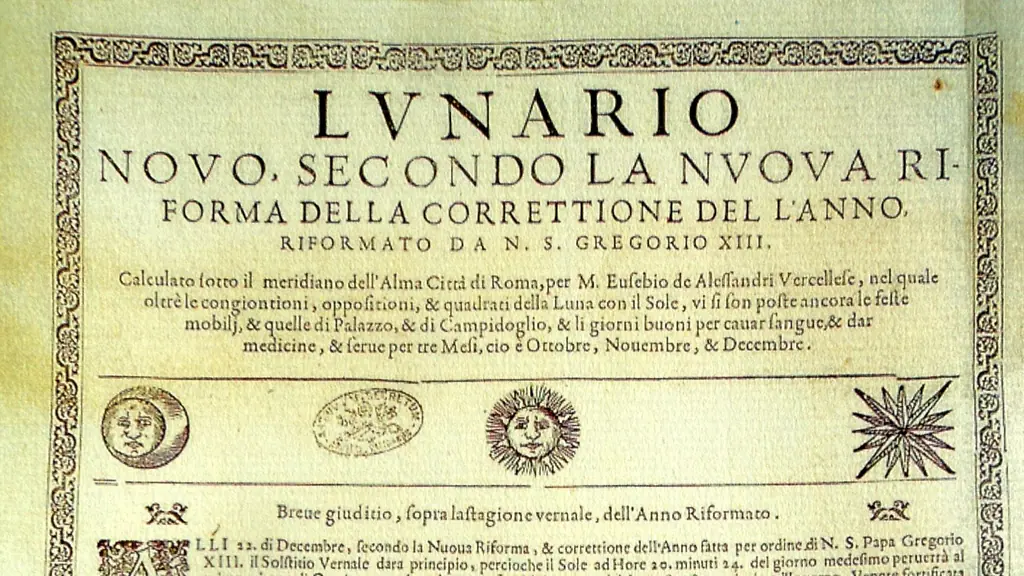
Most of the world now uses the Gregorian calendar, introduced by a papal bull of Pope Gregory XIII in 1582. It corrected the older Julian calendar, which had drifted about ten days out of step with the seasons because it added a leap day every four years without exception. To fix the drift, ten days were dropped: in the countries that adopted the reform immediately, Thursday, October 4, 1582, was followed by Friday, October 15.
The reform also changed the leap-year rule. Under the Gregorian calendar, a year divisible by 4 is a leap year, except century years, which are leap years only if divisible by 400. So 1600 and 2000 were leap years, while 1700, 1800 and 1900 were not.
Not every country switched at once. Great Britain and its colonies, including those that became the United States, kept the Julian calendar until 1752. By then the gap had grown to eleven days, so Wednesday, September 2, 1752, was followed by Thursday, September 14. Britain also moved the start of the year to January 1; earlier, the legal year in England began on March 25.
That is the answer to the Washington puzzle. He was born on February 11, 1731, by the old reckoning. Shift forward eleven days and move the new year to January 1, and the same day becomes February 22, 1732. The National Park Service explains both dates.
Tip: When you quote a date before 1752 from British or colonial American sources, note whether it is "Old Style" (Julian) or "New Style" (Gregorian). Historians often write both, as in "February 11, 1731/32," to make the year clear.
Julian calendar versus Julian Day
Astronomers use something with a confusingly similar name: the Julian Day number, a continuous count of days from noon on January 1, 4713 BCE. It has nothing to do with Julius Caesar's calendar beyond the name, and it makes date arithmetic across centuries easy because there are no months or leap years to track. Many converters show it alongside ordinary dates. If a tool asks whether you want a "Julian date," check which of the two it means.
Other calendars you may meet
- Hebrew calendar. Lunisolar: months follow the Moon, and an extra month is added in seven years of every nineteen to keep holidays in their seasons. Days begin at sunset, so a holiday that "starts on" a given date begins the evening before.
- Islamic calendar. Purely lunar, about eleven days shorter than the solar year, so Ramadan moves through the seasons over roughly a 33-year cycle. Religious observance in many communities depends on sighting the new crescent Moon, so arithmetic converters may differ from announced dates by a day.
- Chinese calendar. Lunisolar, with Lunar New Year falling between January 21 and February 20. Official conversion tables are the safest way to match a Chinese date to a Gregorian one.
- ISO 8601 dates and week numbers. The international standard writes dates as year-month-day (2026-11-27), which sorts correctly and avoids the U.S.–European confusion over 11/12 versus 12/11. Its week 1 is the week containing the year's first Thursday.
Official holidays and time zones
The United States has eleven permanent federal holidays set by federal law (5 U.S.C. 6103): New Year's Day, Birthday of Martin Luther King Jr., Washington's Birthday, Memorial Day, Juneteenth National Independence Day, Independence Day, Labor Day, Columbus Day, Veterans Day, Thanksgiving Day and Christmas Day. Inauguration Day is also a holiday every four years for federal employees in the Washington, D.C., area. When a holiday falls on a Saturday, most federal employees observe it on the preceding Friday; when it falls on a Sunday, on the following Monday. The Office of Personnel Management publishes the observed dates years in advance.
Two cautions. First, federal holidays apply to federal employees and offices; states set their own holidays, and private employers set their own schedules. Second, "Presidents Day" is a popular name, not the legal one: on the federal calendar, the third Monday in February is still Washington's Birthday.
For the correct time, use time.gov, which shows official U.S. time for every U.S. time zone, including those that do not observe daylight saving time, and tells you how far off your device's clock is.
Common date errors and how to avoid them
Checklist: Write dates out in full ("November 27, 2026") or in ISO form (2026-11-27) when readers may be international. Note Old Style or New Style for British and colonial dates before 1752. Check that a converter handles the Julian-to-Gregorian switch the way you expect. Remember that Hebrew and Islamic days begin at sunset. Confirm holiday dates from the official agency, not a calendar printed in another country. In spreadsheets, be aware that Excel's default date system treats 1900 as a leap year, which it was not.
Try it: Use a converter to find the day of the week of July 4, 1776, and of your own birthday in the Hebrew and Chinese calendars. Then find out on which date in 2032 Independence Day will be observed by federal employees, and explain why.
For the history behind particular dates, see our guide to reliable Today in History sources; for quick facts by year, almanacs and fact books online. Skywatchers planning around Moon phases and eclipses will find more on our astronomy and space science page, and other everyday utilities are collected in free online tools every student should know.
Recommended resources
- time.gov — Official U.S. time for every U.S. time zone and UTC, with a check of your device's clock (National Institute of Standards and Technology and U.S. Naval Observatory; free).
- Federal Holidays — The official list of federal holidays and their observed dates for several years ahead, plus historical schedules (U.S. Office of Personnel Management; free).
- Calendar Converter — Converts a date among Gregorian, Julian, Hebrew, Islamic, Persian, Mayan, French Republican and ISO formats, and shows Julian Day numbers; runs in your browser and is in the public domain (Fourmilab; free).
- Calendar FAQ — A long-running, carefully maintained explanation of how the world's major calendars, Easter dating and ISO week numbers work (Claus Tøndering; free).
- Hebcal — Jewish holidays, Hebrew-Gregorian date conversion and candle-lighting times, with downloadable calendars (Hebcal; free, data under a Creative Commons license).
- Gregorian-Lunar Calendar Conversion Table — Year-by-year tables matching Chinese lunar dates and solar terms to Gregorian dates, 1901 to 2100 (Hong Kong Observatory; free PDF and text files).
- NASA's Daily Moon Guide — The Moon's phase and visible features for each day, useful for planning observations or checking historical accounts (NASA; free).
- George Washington's Birthday — A short worked example of the 1752 calendar change and the history of the February holiday (National Park Service; free).
- A Walk Through Time — An illustrated history of calendars and timekeeping, from ancient calendars to atomic clocks (National Institute of Standards and Technology; free).
- timeanddate.com calendars — Printable calendars for any year and country, plus a time zone converter. A commercial site with advertising; double-check holiday dates against official sources (Time and Date AS; free with ads).
Sources
- Federal Holidays, U.S. Office of Personnel Management
- Calendar Converter, Fourmilab
- The Gregorian Calendar (Calendar FAQ), Claus Tøndering
- George Washington's Birthday, National Park Service
- time.gov: Official U.S. Time, NIST and U.S. Naval Observatory