Free Genealogy Research: Census, Archives and Family History Records
Start a family history with free official records: census schedules, military and immigration files, old newspapers, and a way to check online family trees.
Every family has a story that gets repeated at reunions: the great-grandfather who arrived with nothing, the name supposedly changed at Ellis Island, the ancestor said to have fought in a famous battle. Some of these stories are true, some are half true, and some fall apart the moment you look at a record. Genealogy is the work of finding out which is which.
You do not need a paid subscription to begin. Many of the most important U.S. records, including census schedules, military service files, land records and historic newspapers, can be searched free through government archives, national libraries and non-profit projects. This page lays out a sensible order for starting, the free record collections that matter most, and a method for judging the family trees you will inevitably find online.
Start with yourself and work backward
Genealogists work from the known to the unknown, one generation at a time.
- Write down what you already know. Names, dates and places for yourself, parents and grandparents, with a note of how you know each fact.
- Gather home sources. Birth and marriage certificates, obituaries, funeral cards, family Bibles, letters and photographs with writing on the back. Photograph documents rather than removing them from albums.
- Talk to older relatives. Ask open questions about places, jobs, churches and neighbors. Record the date of each conversation and treat what you hear as leads to check, not conclusions.
- Use a chart. The National Archives offers free printable pedigree charts and family group sheets.
- Pick one question. "Where was Grandma Rose's father born?" is easier to answer than "Find all my ancestors."
Tip: Record your source for every fact as you go, even "conversation with Aunt Lena, May 2026." Unsourced notes are the main reason family trees become impossible to untangle later.
The census: your backbone record
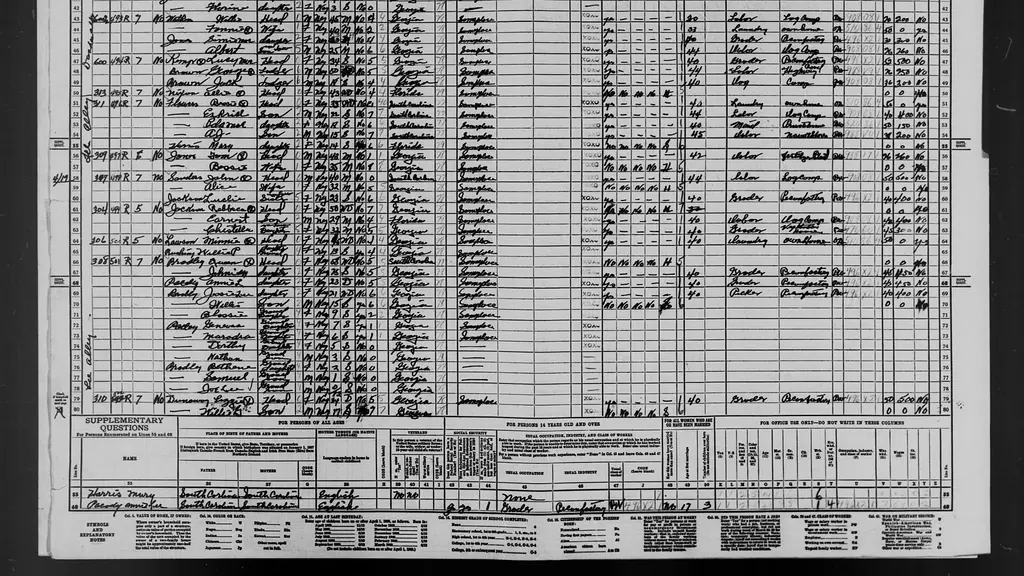
The federal census, taken every ten years since 1790, places a household at a specific address on a specific date and lists who lived there. By law, individual census records stay confidential for 72 years after each census. The National Archives released the 1950 census on April 1, 2022, with free searchable images at a dedicated website, and the 1960 census is scheduled for release in April 2032.
Two quirks catch beginners:
- The 1890 gap. Most of the 1890 population census was destroyed after a fire in the Commerce Department building in Washington, D.C., on January 10, 1921. Only fragments survive, so researchers bridge the 1880 to 1900 gap with state censuses, city directories and other records.
- Spelling and indexing. Enumerators wrote what they heard, and modern indexes are transcriptions of old handwriting. Search for spelling variants, first initials only, or by place and age instead of name.
The Census Bureau notes that many public libraries provide free access to subscription databases containing the census, so ask at your library before paying for anything. Our guide to using your library's databases from home explains how to sign in.
Free record collections to try next
| Record type | What it can tell you | Where to start free |
|---|---|---|
| Military service | Units, service dates, sometimes physical descriptions and pension details | National Archives military records; National Park Service Civil War Soldiers and Sailors Database |
| Immigration and naturalization | Arrival dates, ships, places of origin, citizenship | National Archives immigration and naturalization pages; Ellis Island Foundation passenger search |
| Land | Where an ancestor claimed federal land, and when | Bureau of Land Management General Land Office records |
| Newspapers | Obituaries, marriages, local events, legal notices | Library of Congress Chronicling America |
| Freedmen's Bureau | Records of formerly enslaved people after the Civil War | National Archives Freedmen's Bureau pages |
| Compiled records and indexes | Births, marriages, deaths and parish records from many countries | FamilySearch (free account required) |
Some federal records are not free. The USCIS Genealogy Program, for example, provides historical immigration and naturalization files of deceased immigrants as a fee-for-service program. Vital records such as birth and death certificates usually come from state or county offices, which set their own fees and access rules.
The National Archives' own advice is worth knowing: its catalog search box will not find a specific person by name. Use its genealogy pages and topic guides instead, which point to the right record series and to partner sites that have digitized them. For a broader introduction to archives and digitized newspapers, see researching history online.
Judging online family trees
Shared online trees are full of useful clues and copied mistakes. An error made once can be duplicated across hundreds of trees in a few years. Treat every tree as a hypothesis.
The Board for Certification of Genealogists published the Genealogical Proof Standard in 2000. In plain terms, it asks researchers to search thoroughly, cite sources completely and accurately, analyze and correlate the evidence, resolve conflicts between sources, and write a clear, reasoned conclusion. You can apply the same ideas to any tree you find:
Checklist for an online tree: Does each fact cite a record, not just another tree? Can you see the record image yourself? Do dates make biological sense (no mothers aged eight or sixty-five)? Do places match migration patterns and record locations? Are two people with the same name being merged into one? Does a conflicting record exist that the tree ignores?
It also helps to understand the difference between kinds of evidence. A death certificate is a primary source for the date of death but may be secondhand for the date of birth, which was reported by a grieving relative. Our guide to primary, secondary and tertiary sources covers this distinction.
Try it: Find one grandparent or great-grandparent in the 1950 census. Note the address, everyone in the household, their ages and occupations. Then look for the same family in 1940 and list what changed in ten years.
Privacy and care
Family history involves living people too. Before posting a tree publicly, hide details of living relatives, and ask before sharing photographs or stories that belong to others. Consumer DNA tests can reveal unexpected relationships; read the company's privacy policy and talk with close relatives before testing. For people who lived public lives, our page on biographical research points to additional reference sources, and more collections are listed on the Libraries and Archives subject page.
Recommended resources
- Resources for Genealogists and Family Historians — The National Archives' gateway to census, military, immigration and naturalization records, with how-to videos, workshops and charts. Start here before searching anywhere else. (U.S. National Archives; free.)
- 1950 Census — Free images of the 1950 population schedules, enumeration district maps and descriptions, searchable by name and place. Volunteers can help correct the name index. (U.S. National Archives; free, no account needed to search.)
- Census Records at the National Archives — Explains what each census from 1790 onward asked, where images are available, and how to order copies. (U.S. National Archives; free.)
- Charts and Forms — Printable pedigree charts, family group sheets and census extraction forms for organizing research. (U.S. National Archives; free.)
- FamilySearch — A very large free collection of indexed records and images from many countries, plus a research wiki and a shared family tree. A free account is required to view most records. (FamilySearch; free.)
- Genealogy Research Guides — Library of Congress guides to genealogical sources by topic, record type and ethnic group, written by reference librarians. (Library of Congress; free.)
- Chronicling America — Millions of digitized pages of historic American newspapers with full-text search. Search town names and family surnames for obituaries and local news. (Library of Congress; free.)
- General Land Office Records — Federal land patents and survey records, searchable by name and location, showing where ancestors acquired public land. (U.S. Bureau of Land Management; free.)
- Ellis Island Passenger Search — Search arrival records for passengers who came through the Port of New York, with ship manifests. (Statue of Liberty-Ellis Island Foundation; free to search.)
- Civil War Soldiers and Sailors Database — Basic service information for men who served in Union and Confederate forces, plus regiment histories. (National Park Service; free.)
- The Freedmen's Bureau — Guidance on Freedmen's Bureau records, an essential source for African American family history after the Civil War. (U.S. National Archives; free.)
- USCIS Genealogy Program — How to request historical immigration and naturalization files for deceased immigrants. Index searches and record requests carry fees. (U.S. Citizenship and Immigration Services; paid.)
- The Genealogy Center — One of the largest public genealogy libraries in the United States, with free online databases and research guidance. (Allen County Public Library; free.)
- The USGenWeb Project — Volunteer-run state and county pages with transcribed records, local research tips and links. Quality varies by county, so check transcriptions against originals. (USGenWeb volunteers; free.)
- BCG Ethics and Standards — The Board for Certification of Genealogists' standards, including the Genealogical Proof Standard, for researchers who want to work to a professional level. (Board for Certification of Genealogists; free to read.)
Sources
- Resources for Genealogists and Family Historians, U.S. National Archives and Records Administration
- Census Records, U.S. Census Bureau
- 1890 Census, U.S. National Archives and Records Administration
- 1950 Census, U.S. National Archives and Records Administration
- Ethics and Standards, Board for Certification of Genealogists