Famous Quotations: How to Find Them and Check Who Really Said It
How to trace a famous quotation to its original source, spot misattributions, and use quotation dictionaries, Wikiquote, Quote Investigator and digitized books.
Imagine you are finishing a graduation speech and want an opening line. A poster in the school hallway credits Gandhi with "Be the change you wish to see in the world." A meme credits Einstein with defining insanity as doing the same thing over and over and expecting different results. Both lines are famous, both are inspiring, and neither, as far as researchers can tell, was said in that form by the person whose name is attached to it.
Quotations travel well because they are short, and they lose their sources for the same reason. This page explains why misattribution happens, shows a step-by-step method for tracing a quotation back to where it first appeared, and points to the reference works and digital collections that make the search possible.
Why so many quotations are wrong
Researchers who trace quotations see the same patterns again and again:
- Drift toward the famous. A memorable line said by a little-known person gets reassigned to someone more quotable: Lincoln, Twain, Churchill, Einstein, Gandhi. Fame makes a quote spread faster, so the wrong version wins.
- Paraphrase hardening into quotation. Someone summarizes an idea, and later writers put the summary in quotation marks.
- Lost context. A line spoken by a character in a novel or play gets attributed to its author as a personal belief.
- No citation at all. Quote websites, posters and social media posts rarely say where a line was published, so errors copy freely.
The two examples above show how this works. Quote Investigator, a long-running research site, found that Gandhi wrote something related in 1913, an observation that if we could change ourselves the tendencies in the world would also change, but the short "be the change" phrasing does not appear in his writings; the closest early match it found is from a 1974 book by an American educator. For the insanity line, the earliest strong match it found is a 1981 newspaper report of a twelve-step support meeting, with no evidence connecting it to Einstein, who died in 1955.
The International Churchill Society keeps a whole page of lines Churchill never said, and Wikiquote, the free quotation wiki, sorts many people's pages into sourced, "Disputed" and "Misattributed" sections. When even the subjects' own scholarly societies maintain lists of fakes, it is wise to treat any unsourced quotation as a claim to be checked.
How to trace a quotation, step by step
You do not need special access to do a basic check. Allow ten to twenty minutes.
- Write down the exact wording and the claimed author. Note any variant wordings you have seen; they are clues.
- Check a fact-checking source first. Search Quote Investigator and the person's Wikiquote page. If either has already traced the line, read the evidence and note the earliest source they found.
- Look for a citation, not just an attribution. A real citation names a specific work, date and page: a speech, letter, book or interview. "Attributed to" or a name alone is not a citation.
- Go to the primary source if you can. Collected papers and speeches are often online: Founders Online for Washington, Adams, Franklin, Jefferson, Hamilton, Jay and Madison; the Papers of Abraham Lincoln; presidential speech archives. Search the text for a distinctive phrase.
- Search digitized books and newspapers by date. Use Google Books, the Internet Archive or HathiTrust, and newspaper archives such as the Library of Congress's Chronicling America. Search a distinctive phrase in quotation marks, then sort or filter by date to find the earliest appearance.
- Compare the earliest version with the famous version. Often you will find the idea, worded differently, by a different person, decades earlier.
- Decide how confident you are. If you find the line in the author's own published work, cite that. If the earliest appearance comes years after the person's death, treat the attribution as doubtful.
Try it: Pick a quotation from a classroom poster or a social media post. Follow steps 1 to 5 and record the earliest dated appearance you can find. Did the wording or the speaker change along the way?
Quotation dictionaries and what they are good for
Printed quotation dictionaries remain useful because their editors check sources. They differ in how carefully they do it:
| Source | Strengths | Access |
|---|---|---|
| The New Yale Book of Quotations (2021), edited by Fred R. Shapiro | More than 12,000 quotations; corrects many misattributions and credits original speakers, including women whose words were assigned to famous men | Print; check your library |
| Respectfully Quoted (Library of Congress, 1989) | Built from quotations the Congressional Research Service was asked to verify for members of Congress; includes notes on sources and on attributions that could not be confirmed | Borrowable copy on the Internet Archive; many libraries |
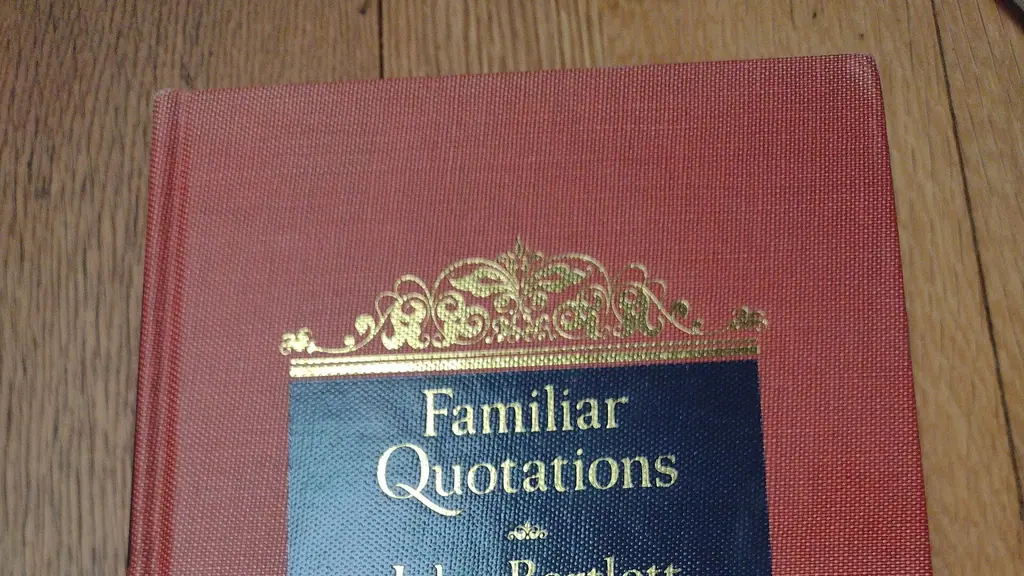
| Bartlett's Familiar Quotations | A classic, long-running anthology; older editions are now in the public domain | Older editions in digital libraries; current edition in print |
| Oxford quotation dictionaries | Several subject-specific titles, searchable online | Oxford Reference, often available free through a public or school library |
| Wikiquote | Free, broad, with Disputed and Misattributed sections | Open web; quality varies, so check its citations |
Older anthologies are not infallible. A nineteenth-century collection may repeat errors that were already circulating, which is why modern researchers prefer the earliest dated source over any anthology's say-so.
Using a quotation correctly in your own work
Once you have found a trustworthy source:
- Quote exactly, including the original punctuation, and use an ellipsis (…) for omitted words. Do not tidy the wording to match the popular version.
- Cite where you found it. If you read it in a secondary source, say so: "quoted in" is an honest citation. Purdue OWL explains when to quote, paraphrase or summarize, and our guide on how to cite online sources shows the formats.
- Attribute carefully when the trail is uncertain. "A saying often attributed to Einstein, though there is no evidence he said it" is accurate and still lets you use the line.
- Keep quotations short and make sure they support your point rather than replace it.
A quotation is a claim like any other, and the same habits apply. Our guide to fact-checking a claim in five minutes covers lateral reading, and primary, secondary and tertiary sources explains why the earliest source carries the most weight. For more reference works, see the Reference Desk.
Checklist: exact wording recorded; Quote Investigator and Wikiquote checked; a real citation (work, date, page) found or not found; earliest dated appearance noted; attribution worded to match the evidence.
Recommended resources
- Quote Investigator — Detailed, dated investigations of thousands of popular quotations, each tracing the earliest known appearances; search before you quote (independent researcher; free; advertising).
- Wikiquote — Free collaborative collection of sourced quotations; many pages separate sourced lines from "Disputed" and "Misattributed" ones. Always follow its citations (Wikimedia Foundation; free).
- The New Yale Book of Quotations — The 2021 edition of a research-based quotation dictionary that emphasizes accurate origins; ask your library for a copy (Yale University Press; paid book).
- Respectfully Quoted — The Library of Congress's 1989 dictionary of quotations researched for Congress, with notes on sources and unconfirmed attributions (Internet Archive; free account needed to borrow).
- Quotes Falsely Attributed to Winston Churchill — A specialist society's list of popular lines Churchill did not say, a model for how to check a single person's quotations (International Churchill Society; free).
- Founders Online — Searchable, annotated papers of seven leading founders, ideal for checking quotations credited to Jefferson, Franklin, Washington and others (National Archives and University of Virginia Press; free).
- Papers of Abraham Lincoln — A documentary edition of Lincoln's writings and correspondence, useful for checking the many sayings credited to him (Papers of Abraham Lincoln project; free).
- Google Books — Full-text search across millions of digitized books; use exact-phrase searches and date filters to find early appearances (Google; free; previews vary by copyright).
- Internet Archive — Digitized books, magazines and older quotation anthologies with full-text search (nonprofit; free; account needed to borrow in-copyright books).
- HathiTrust Digital Library — Full-text search of books from research libraries; public-domain volumes can be read in full (university library partnership; free).
- Chronicling America — Historic American newspapers with full-text search, valuable for finding when a saying first appeared in print (Library of Congress; free).
- Purdue OWL: Quoting, Paraphrasing, and Summarizing — Clear guidance on when and how to quote in academic writing (Purdue University; free).
Sources
- Quote Origin: Be the Change You Wish To See in the World, Quote Investigator
- Quote Origin: Insanity Is Doing the Same Thing Over and Over Again and Expecting Different Results, Quote Investigator
- Quotes Falsely Attributed to Winston Churchill, International Churchill Society
- The New Yale Book of Quotations, Yale University Press
- Respectfully Quoted: A Dictionary of Quotations Requested from the Congressional Research Service, Library of Congress (via Internet Archive)
- Quoting, Paraphrasing, and Summarizing, Purdue Online Writing Lab