The Da Vinci Code: Separating Historical Fact from Fiction
Using Dan Brown's 2003 novel as a case study in checking historical claims: the Priory of Sion, Opus Dei, Leonardo's Last Supper and the Council of Nicaea.
Dan Brown's The Da Vinci Code was published in 2003 and became one of the best-selling novels of its time; Britannica reports sales of more than 80 million copies. Its plot follows a symbology professor through the Louvre, secret societies and coded messages in Leonardo da Vinci's paintings, and it presents a sweeping alternative history of early Christianity. The 2006 film adaptation brought the story to an even larger audience.
The novel is fiction, but it opens with a page headed "Fact" that vouches for the existence of a secret society and the accuracy of its descriptions of artworks, architecture, documents and rituals. That blend of thriller and confident assertion makes it an excellent case study for anyone learning to check historical claims. This page works through four of the book's best-known claims, shows how to test them against reliable sources, and ends with a method you can apply to any "hidden history" you encounter.
Why a novel is worth fact-checking
Readers do not usually fact-check thrillers. The Da Vinci Code is different because many readers came away believing that its historical framework was real, and because its techniques are the same ones used by persuasive misinformation: a confident narrator, authentic-sounding detail, real places and people mixed with invention, and an appeal to secret knowledge that "they" do not want you to know.
The point is not to spoil the novel. It is perfectly reasonable to enjoy it as a story. The skill is being able to tell which parts would survive contact with the evidence.
Claim 1: The Priory of Sion is an ancient secret society
The novel's version: a centuries-old brotherhood guarding a great secret, with famous members including Leonardo.
What the evidence shows: The Priory of Sion was a small association registered in France in 1956 by Pierre Plantard. The sociologist of religion Massimo Introvigne, in a detailed FAQ on the subject, documents that the "Dossiers secrets" listing its supposed grand masters were deposited at France's national library in the 1960s, and that the people involved, including Plantard and his associate Philippe de Chérisey, later acknowledged that documents at the heart of the story were fabricated. The supposed medieval history appears in no medieval source.
Lesson: A document sitting in a famous library is not evidence of its contents. Ask when it was created, by whom and why.
Claim 2: Opus Dei is a sinister monastic order
The novel's version: a menacing organization whose agent is a murderous monk.
What the evidence shows: Opus Dei is a Catholic organization founded in Spain in 1928 by the priest Josemaría Escrivá. Britannica describes its members, both laypeople and clergy, as seeking holiness through ordinary everyday work, and notes that it is neither a sect nor a religious order whose members take formal vows. It has no monks. It has also been genuinely controversial: Britannica records accusations of secrecy and other criticisms, and Opus Dei has rejected the novel's portrayal.
Lesson: Fiction often exaggerates a real controversy into something it is not. Look for an accurate description of the real organization, including its critics' strongest documented points, rather than accepting either the fictional portrait or the organization's own publicity uncritically.
Claim 3: The Last Supper hides a secret message
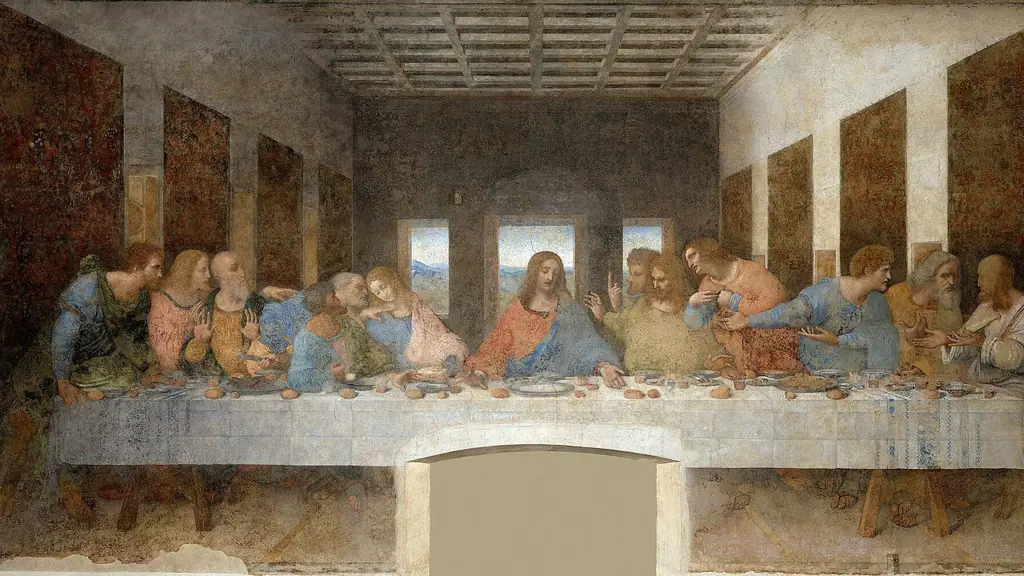
The novel's version: the figure seated at Jesus's right is not the apostle John but Mary Magdalene, and the composition encodes a hidden truth.
What the evidence shows: Leonardo painted the Last Supper probably between 1495 and 1498 on the refectory wall of the Dominican convent of Santa Maria delle Grazie in Milan. Britannica explains that it depicts the moment Jesus announces that one of the apostles will betray him, with each apostle reacting in character. Art historians identify the youthful, beardless figure beside Jesus as John, who was conventionally shown that way in Italian paintings of the scene.
The painting's physical history matters too. Smithsonian Magazine notes that Leonardo used an experimental technique on dry plaster, and the work began to deteriorate soon after it was finished. What viewers see today reflects centuries of damage and repeated restoration, most recently a long campaign completed in 1999, which makes fine "hidden" details an especially weak foundation for theories.
Lesson: Interpretations of artworks should start with what scholars know about the work's subject, conventions, patron and condition. A striking visual impression is a question, not an answer.
Try it: Find two other Italian Last Supper paintings from the fifteenth century and look at how the apostle John is depicted. What do you notice? Then read Britannica's article on Leonardo's version and compare your observations with the novel's claim.
Claim 4: Jesus's divinity was invented by a vote at Nicaea
The novel's version: the early church decided Jesus was divine through a close vote at the Council of Nicaea in 325, for political reasons.
What the evidence shows: The First Council of Nicaea was called by the emperor Constantine I. According to Britannica, its central business was the controversy over Arianism, the teaching of Arius that Christ was a created being rather than fully divine. The council condemned Arius and adopted a statement of faith declaring Christ to be of the same divine nature as God. Belief in Christ's divinity was not new in 325; the dispute was over how that divinity should be understood.
Lesson: Check how a historical event is described by specialists, and be wary of dramatic simplifications such as "a close vote" that turn long, documented debates into a single moment.
A method you can reuse
Checklist: (1) Identify the specific claim, not the general mood. (2) Ask what kind of source would settle it: a primary document, a museum record, specialist scholarship? (3) Read laterally: open new tabs and see what independent experts say. (4) Separate real people and places from invented events. (5) Check whether "secret" evidence was created long after the period it supposedly describes. (6) Decide what you can say with confidence, and what remains uncertain.
These steps are the same ones used in our guides on evaluating online sources and fact-checking a claim in five minutes. For help choosing between first-hand and later accounts, see Primary, Secondary and Tertiary Sources, and for choosing a trustworthy reference work, Free Online Encyclopedias. A very different mystery, in which careful method did produce a real solution, is covered on our page about the Zodiac ciphers. More guides are collected under Digital Literacy.
Tip: Teachers can pair a chapter of the novel with one reliable source per claim. Students mark each statement as documented, disputed or invented, and cite the source that supports their judgment.
Recommended resources
- Last Supper (Britannica) — A thorough, edited overview of the painting's subject, composition, technique and condition, with a guide to the figures (Encyclopaedia Britannica; free to read).
- Cenacolo Vinciano: Leonardo's Last Supper Museum — The official site of the museum that houses the painting, with history, conservation information and visitor booking; reservations are required for all visits (Museo del Cenacolo Vinciano; free site, paid admission).
- See 'The Last Supper' in a New High-Resolution Scan Online — Explains why the original deteriorated and introduces a gigapixel scan of an early copy by Leonardo's pupils (Smithsonian Magazine; free).
- Leonardo da Vinci (1452–1519) — A concise scholarly essay on Leonardo's life and work from a major art museum's Heilbrunn Timeline of Art History (The Metropolitan Museum of Art; free).
- e-Leo Digital Archive — High-quality digital reproductions and transcriptions of Leonardo's manuscripts, so you can see his actual notebooks (Biblioteca Leonardiana, Vinci; free).
- Veneranda Biblioteca Ambrosiana — The Milan library and gallery that holds Leonardo's Codex Atlanticus, the largest collection of his drawings and notes (Biblioteca Ambrosiana; free site).
- Opus Dei (Britannica) — An independent overview of the organization's history, structure and controversies (Encyclopaedia Britannica; free to read).
- Opus Dei (official site) — The organization's own description of its beliefs and activities; useful as a primary source for how it presents itself, read alongside independent accounts (Opus Dei; free).
- First Council of Nicaea (Britannica) — What the council of 325 actually addressed, including the Arian controversy and the Nicene Creed (Encyclopaedia Britannica; free to read).
- The Da Vinci Code FAQ, or Will the Real Priory of Sion Please Stand Up? — A detailed, sourced history of the Priory of Sion hoax by a scholar of new religious movements (CESNUR; free).
- Mona Lisa (Louvre collections) — The Louvre's official catalog record for the painting, with its documented history and provenance (Musée du Louvre; free).
- Civic Online Reasoning — Free lessons that teach lateral reading and evaluating claims, well suited to a Da Vinci Code fact-checking unit (Digital Inquiry Group; free).
Sources
- The Da Vinci Code (novel by Brown), Encyclopaedia Britannica
- Last Supper (painting by Leonardo da Vinci), Encyclopaedia Britannica
- Opus Dei, Encyclopaedia Britannica
- First Council of Nicaea, Encyclopaedia Britannica
- The Da Vinci Code FAQ, or Will the Real Priory of Sion Please Stand Up?, CESNUR (Center for Studies on New Religions)
- See 'The Last Supper' in a New High-Resolution Scan Online, Smithsonian Magazine